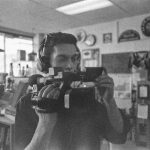
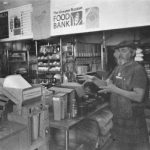
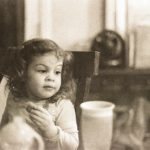
On St. Patrick’s Day 2017, Paul & Matt from Hunt’s Education took a trip to visit our friend Eamon and his staff at the Modern Homebrew Emporium in Cambridge. Our goal: To develop film using beer (and a few other things)!
To preface this assignment it is worth establishing that we are not chemists at Hunt’s Education, nor are we really science-saavy. We are basing our “recipe” off of a few ideas that we saw at this site as well as reading a few other recipes from elsewhere on the web. We’re not trying to reinvent the wheel here, but instead, just doing what we think we do best here at Hunt’s Photo: Spreading the word and trying to have a good time while doing it!
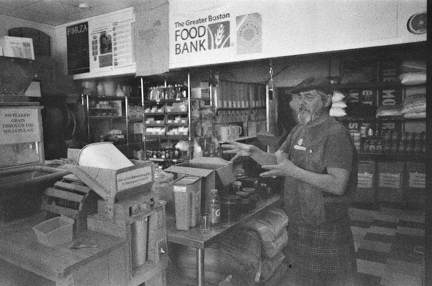 We chose to use the Modern Homebrew Emporium in Cambridge because homebrewers love fun beer-related projects, and their manager, Eamon, is a great personality to work with for such a project.
Our basic recipe was as follows:
-1 can Guinness, warmed to about 85-90 degrees
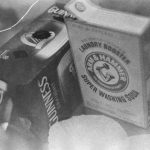
-50 grams Washing Soda (Arm & Hammer; specifically not Baking Soda. The active ingredient we are looking for here is Sodium Bicarbonate!)
-10 grams Vitamin C tablets, crushed
-1 teaspoon of table salt
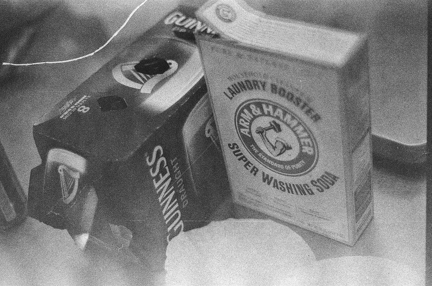 Warm the beer to the above temperature. Dissolve the washing soda first, then add the Vitamin C and salt. (Very important: If you add all together, the result will gush!)
After dissolving (which takes some time), pour the beer into your developing tank. Agitate for the first minute, then for 10 seconds every minute for 15 minutes total. Use stop bath for 1 minute to stop development, then fixer for 5 minutes. For stop bath, we used water and for fixer, we used Ilfofix.
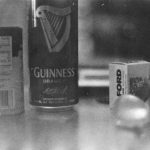
Our resulting images were very dense, but clearly visible! We repeated this process using half the amount of washing soda (25g) keeping all other variables the same. My thought process on this was that the dense negatives created an overexposed image. However, these results produced an even denser negative which produced visible images again, but much less distinguishable from the background.
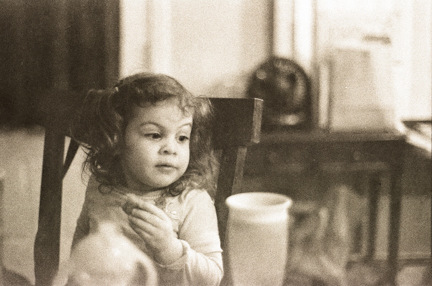 Later in the evening, while at home, I switched it up and used an old bottle of Smuttynose IPA and back up to 50g of Washing Soda. Our results were similar to that of the original batch. Ultimately, the beer style didn’t matter, just the fact that we had some kind of slightly acidic liquid reacting with the chemistry. (Or so says the guy with no chemistry degree!) When choosing our beer, we specifically started with Guinness because…everyone knows Guinness and they equate it with the St. Patty’s Day holiday. Again, nothing too technical here.
This was a truly fantastic experiment, one which we plan to test out again in the future. Feel free to comment below on our very non-scientific experiment! But first, a gallery of sample images from the afternoon! Enjoy!